S a c r e d R i t u a l s & C e r e m o n i e s
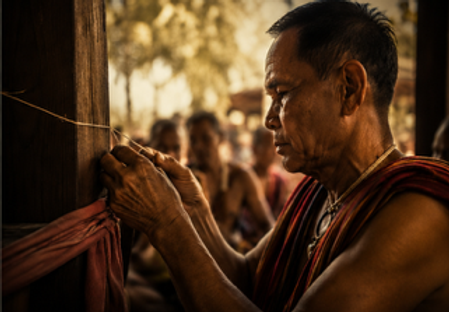
For generations, elephant rituals have been deeply rooted in the traditions of the Kuy (Kuay) people of Surin Province — reflecting reverence for elephant masters, ancestral spirits, and the sacred bond between humans and elephants.
These ceremonies were not merely symbolic. They were part of a spiritual system that guided the lives of mahouts, elephant healers, and elephant-catching expeditions.
The Wai Kru Pakam Ceremony
.png)
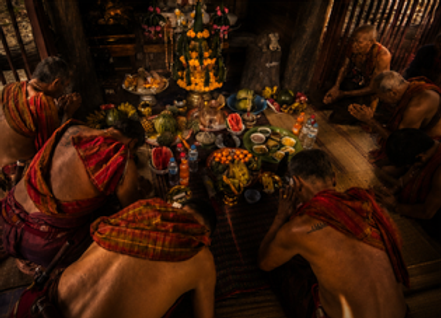
One of the most important rituals was the Wai Kru Pakam ceremony — an annual rite held to honor sacred spirits, elephant masters, and the ancestral guardians connected to the Pakam rope.
Offerings such as rice whisky and boiled chicken were presented before the sacred Pakam rope, traditionally made from buffalo hide and believed to carry spiritual power and protection.
Before entering the forest to capture wild elephants, mahouts also performed a form of divination using the boiled chicken. If the chicken’s jawbone was pulled out straight, slender, and beautifully pointed, it was considered a powerful sign of safety and success. The expedition could proceed with confidence and blessing.
But if the jaw appeared twisted, bent, or deformed, the journey would be cancelled immediately. It was believed to be a warning of danger — a sign that someone could be injured or killed by elephantsin the forest.
To outsiders, these practices may seem like superstition. But for the men who entered deep forests to face wild elephants, they were rituals of caution, humility, and respect toward forces far greater than themselves.
However, the Pakam shrine was not treated as an ordinary spirit house, but as a sacred ceremonial space reserved for elephant masters. Traditionally, women were forbidden from touching the shrine, the Pakam ropes, or ritual objects associated with elephant-catching ceremonies.
Only mahouts and initiated elephant masters were allowed to enter the shrine area or conduct the rituals. Within traditional belief systems, these restrictions were connected to ideas of spiritual purity, ritual protection, and respect toward the ancestral spirits believed to guard the Pakam tradition.

The Pa Shi Ceremony (Elephant Master Ordination)
A ritual performed to formally appoint or elevate a mahout or elephant healer. Senior elephant masters would conduct blessings, ward off evil spirits, and symbolically recognize the individual as a true guardian of elephants.


The Elephant Blessing Ceremony
Held to express gratitude to elephants for their labor, companionship, and protection. Elephants were regarded not merely as animals, but as members of the household and bearers of prosperity.
The Phajaan Ritual — Separation, Transition, and Misunderstanding
The word Phajaan is often translated simply as “breaking,”
but within traditional elephant culture, its deeper meaning was closer to “separation” or “transition.”
Historically practiced among some Kuy communities of Surin and elephant traditions in Northern Thailand, the ritual marked the moment when a young elephant began separating from its mother in order to enter a new stage of life — learning discipline, responsibility, work, communication with humans, and life within elephant society beyond maternal dependence.
The ceremony itself traditionally involved spiritual rituals, offerings, chants, blessings, and symbolic acts intended to prepare both mother and calf for separation.
In some traditions, elephant masters performed protective prayers to calm fear, reduce unhealthy attachment, and ask for safety and guidance from ancestral spirits.
.png)
At its core, the ritual reflected a reality familiar even in human life: there comes a time when a child must begin stepping away from constant maternal attachment in order to grow emotionally stronger and more independent. A child cannot remain permanently dependent on their mother forever.
it is not so different from human life — there comes a time when children must leave the safety of their mother’s arms, go to school, face the world, and gradually grow into independent individuals.
A mother cannot protect or cling to her child endlessly without limiting that child’s growth, confidence, and emotional resilience.
In traditional elephant culture, this understanding was applied to elephants as well.
However, in modern times, the Phajaan ritual has increasingly been distorted and sensationalized for marketing purposes.
Some campaigns and media productions have presented staged or exaggerated depictions of extreme cruelty in order to create emotionally shocking narratives for fundraising, tourism branding, and “compassion marketing.”
These portrayals often ignore the deeper cultural, spiritual, and practical meanings behind the tradition, reducing a complex historical relationship into simplified images designed to provoke pity and outrage.
This has contributed to widespread misunderstandings about traditional Thai elephant culture and the long relationship between elephants and mahouts.
None of this means every historical practice was perfect, nor that traditions should never evolve. But portraying an entire culture solely through carefully selected scenes of brutality erases the realities of coexistence, responsibility, survival, and emotional understanding that shaped elephant life for generations.
For many traditional elephant families, the ritual was never simply about cruelty. It was about transition, responsibility, emotional maturity, and preparing both elephant and human for the realities of life ahead.
.png)
The Elephant Round-Up Ceremony (Khlong Chang)
The traditional elephant round-up was the process of bringing wild elephants into human society for work, warfare, transportation, and royal service.
Before entering the forest, mahouts first performed the sacred Wai Kru Pakam ritual. Through offerings, prayers, and divination using the jawbone of a boiled chicken, they sought permission and protection from ancestral spirits and the guardians of the sacred Pakam rope.
If the omen appeared favorable, the expedition could proceed. If the sign was considered bad, the journey would be cancelled, as it was believed danger or death could await in the forest.
.png)
.png)
Although methods varied between regions and elephant communities, the process relied heavily on skill, patience, spiritual belief, and deep understanding of elephant behavior.
Mahouts often used their own trained elephants as decoys or guides to approach wild herds. To avoid detection, some mahouts tied themselves beneath the belly of their elephant and covered their bodies with elephant dung and urine to mask human scent while moving through the forest. Using the sacred Pakam rope — traditionally made from buffalo hide and believed to possess spiritual power — mahouts attempted to lasso the legs of wild elephants.
Once captured, the elephants were often guided toward rivers, where they were washed and cleaned as part of the initial handling process.Not all captured elephants were treated the same.
If an elephant displayed characteristics associated with royal white elephants or unusually auspicious traits, it could be presented directly to the king. Large and powerful elephants were often selected for warfare and military transport, while medium-sized elephants commonly entered civilian life, assisting with logging, agriculture, transportation, and heavy labor.
The entire process was surrounded by strict spiritual beliefs and taboos. While the mahouts were away in the forest, wives were traditionally forbidden from bathing, washing their hair, or excessively cleansing their bodies. Violating these taboos was believed to bring danger or misfortune upon their husbands during the expedition.
However, some historians and cultural observers believe these restrictions may also have functioned as social customs intended to reinforce loyalty and discourage adultery while husbands were away for long periods in dangerous forests.
To modern audiences, many of these practices may seem mystical or superstitious. But within traditional elephant culture, they reflected a world where survival, spirituality, danger, loyalty, and the human-elephant relationship were deeply intertwined.
Today, wild elephant round-ups no longer take place in Thailand, as elephants are now protected animals under modern wildlife protection laws.However, some elephant camps and cultural events still organize reenactments or staged demonstrations of traditional elephant round-up ceremonies in order to preserve historical memory and allow younger generations to understand this important part of elephant culture and Thai history.
.png)